Photos: Liz Hassett
Ember to Aftermath brought wildfire experts and AI developers together during the inaugural New Mexico Tech Week; three winning concepts address early detection, fire forecasting and home preparedness
When wildfire destroyed Curt Doty’s mother’s home in Paradise, California, her survival depended on a binary decision made with frighteningly little information. Escaping with a neighbor, she faced a choice about which direction to drive as the emergency unfolded. Left or Right. They turned right heading farther into the mountains, a decision that ultimately saved their lives. Those who turned left heading down to Chico were ultimately surrounded by fire with many dying in their cars. His mother later relocated to Santa Fe, where her experience gave her son a deeply personal reason to pursue better wildfire information, preparedness and protection.
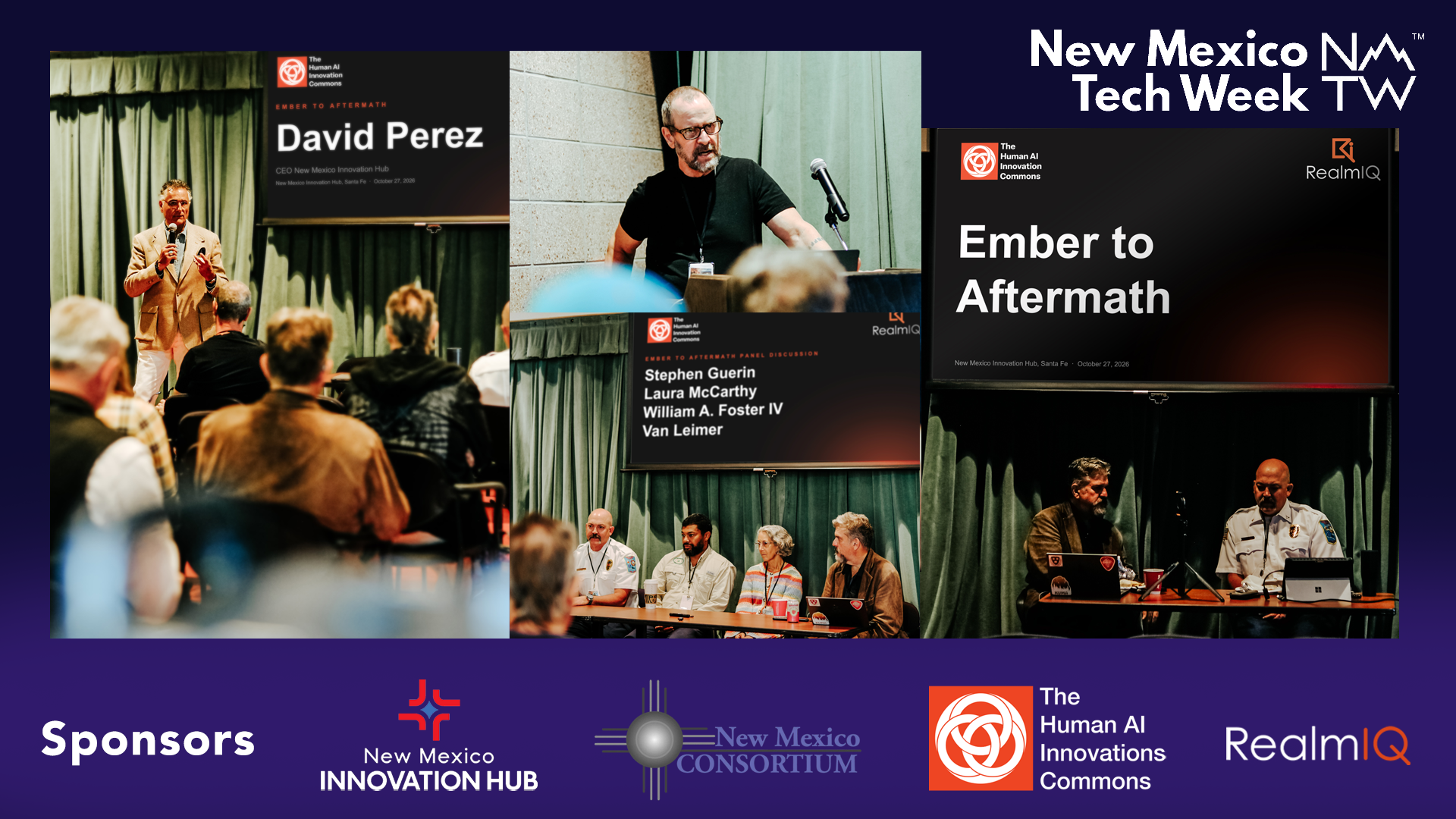
That motivation helped bring Ember to Aftermath to life: On October 27, the AI hackathon connected wildfire professionals, entrepreneurs, developers and community members to explore practical solutions before, during and after a fire. Hosted at the New Mexico Innovation Hub as part of the first New Mexico Tech Week, the event paired expert presentations and direct questioning with a concentrated development sprint and demonstrations before judges.
Three winning solutions emerged: Fire Sentry, a ground-sensor network for wildfire monitoring; FireSpread, a community camera network combining corroborated smoke detection with work toward fire forecasting; and Ember Ready, a homeowner-focused application for identifying property vulnerabilities. Together, the concepts demonstrated how human expertise and AI-assisted development could support several layers of community protection.
Doty initiated the effort by asking longtime colleague Jeff Boortz to help create an AI hackathon. Boortz sponsored and created the hackathon’s concept and framework, developing its wildfire focus, rules and parameters. An Emmy-winning creative director and brand strategist, Boortz brought his interest in human imagination, invention and the distribution of AI’s economic benefits to the design of the event.
Rather than starting with a predetermined product, the organizers invited participants to learn directly from people managing wildfire risk. The format gave developers a chance to question assumptions, identify specific needs and build around the experience of professionals and residents whose lives and work are affected by fire.
Expertise Before Experimentation
The morning program established the ecological, operational and economic context for the afternoon’s development work. Speakers included New Mexico State Forester Laura McCarthy; William A. Foster IV, Forest Markets Manager for the New Mexico Energy, Minerals and Natural Resources Department’s Forestry Division; Van Leimer, Wildland Division Chief of the Los Alamos Fire Department; Stephen Guerin, founder of Simtable; and David Perez, founder and CEO of the New Mexico Innovation Hub.
Their presentations gave participants a view of wildfire that extended beyond detecting flames. Topics included forest conditions, beneficial fire, evacuation decisions, communications failures, home vulnerability, recovery, biomass markets and the difficulty of coordinating information across agencies and communities. The discussion helped teams understand where technology might contribute and where practical constraints require deeper investigation.
“This was my first experience at an AI Hackathon. The morning presentations by wildfire experts, followed by a question and answer with AI hackers, brought up lots of new ideas. I was curious to learn what the hackers would come up, so I returned to hear their presentations to the judges. It’s a good model to catalyze innovation.” — Laura McCarthy, New Mexico State Forester.
McCarthy described wildfire as an interconnected ecological, social and management challenge. Forest conditions, accumulated fuels and climate extremes influence fire behavior, while severe burns can produce flooding, debris flows and uncertain recovery. She also emphasized learning from Indigenous communities whose longstanding practices include cultural burning and managing varied vegetation patterns across the landscape.
Chief Leimer brought an operational perspective from Los Alamos, where steep canyons, difficult access and specialized laboratory environments complicate response. He discussed equipment, drones, cameras, training and home assessments, while stressing the importance of coordinated mitigation across property boundaries. Finding a fire is only one step; responders must also reach it, communicate conditions and obtain available resources.
Guerin explored community-controlled information sharing, including distributed imagery and conversational AI interfaces. His “digital acequia” concept drew on New Mexico’s tradition of communally managed irrigation systems to describe an information network built around participation and permission. The approach raised questions about how residents could contribute useful observations while retaining control over their data.
Forest Restoration as an Economic Opportunity
Foster’s presentation broadened the innovation challenge by asking what happens to the material removed through forest thinning. Without sufficient buyers, processing capacity, transportation and storage, biomass can remain an obstacle to restoration. Creating viable markets could help turn that material into income for landowners, business opportunities and jobs in rural communities.
Potential applications discussed included bioplastics, sustainable aviation fuel and biomass-based heat and electricity. Foster emphasized that New Mexico should capture the value of processing its resources locally. Exporting raw material alone would leave much of the economic benefit elsewhere, weakening the opportunity to connect healthier forests with stronger local economies.
He also identified specific openings for technology: estimating biomass on a property, connecting landowners with industry, tracking inventories, improving transportation and developing better pricing information. His Forest Tech Collaborative work with New Mexico Tech and Navajo Technical University illustrated how students and institutions can help address gaps between land management and markets.
Although the three winning demonstrations focused on detection, forecasting and preparedness, the biomass discussion showed participants that wildfire innovation reaches well beyond emergency response. Software developers, logistics specialists, engineers and entrepreneurs can contribute to a system that makes preventive work more consistent and economically sustainable.
Three Winning Solutions
Fire Sentry: Ground-Level Data for Earlier Awareness
Presented by Dominic Siegele, Fire Sentry proposed a network of sensors measuring smoke particles, gases, temperature, humidity, wind and other environmental conditions. The concept would move readings through a long-range wireless network to a gateway, with cellular communication and satellite backup connecting the system to a dashboard.
Dominic demonstrated a working sensor prototype and dashboard using measurements collected while driving near active fires. Particle readings increased as the prototype approached the fires, showing its ability to record changing conditions. He described using Claude during development to examine sensor choices, assess readings and challenge assumptions, while maintaining human oversight of design decisions.
The longer-term ambition is to combine ground measurements with machine learning to recognize early warning signs and help anticipate fire movement. Field deployment, predictive-model development, false-alarm reduction and hardware resilience remain important next steps. The proposed network is intended to complement cameras and satellites by adding localized measurements from the ground.
FireSpread: Confirming Smoke Through Multiple Viewpoints
Holly Grimm presented FireSpread, a community-scale camera concept designed to corroborate smoke detections before raising an alert. A sighting from one camera remains unconfirmed until another viewpoint supports it. That approach aims to reduce false positives from clouds, dust, insects and other visual distractions while helping locate a possible fire.
The proposed architecture processes imagery locally at camera-connected devices and sends alert information to a shared dashboard. Local processing is intended to reduce the amount of neighborhood footage transmitted to a central system. The demonstration showed the alert and triangulation workflow, followed by a separate forecast visualization using historical Hermits Peak fire data.
The forecast compared predicted burning with observed fire boundaries, making both matches and errors visible. The demonstration used scripted alerts and approximate camera locations, and detection was not yet integrated with forecasting. Further development would connect those components, validate performance and determine how to turn technical findings into clear information for residents and responders.
Ember Ready: Helping Homeowners Identify Vulnerabilities
Carlos Alvarez and his team presented Ember Ready, a mobile-friendly application intended to help residents understand and reduce wildfire vulnerabilities around their homes. The concept combines aerial imagery, photographs taken by homeowners, AI-assisted visual analysis and a guided checklist to produce a private assessment and prioritized recommendations.
During the demonstration, the application identified potential concerns in property photographs and marked areas for review. Examples included combustible fencing and vegetation near a structure. The intended workflow would help residents examine issues such as debris, firewood placement and other conditions they could address before a wildfire threatens their neighborhood.
The team used ChatGPT to support application development. Its final scoring and action-plan functions were still under development, and the presenters discussed stronger privacy protections and expert validation as necessary next steps. Future possibilities included telephone alerts for people who rely on landlines, reflecting a commitment to making useful information accessible beyond smartphone users.
A Place for Collaboration
The New Mexico Innovation Hub graciously hosted Ember, providing space for presentations, discussion and team development. Organizers thanked David Perez, Kelly Stanhope and the Hub community, along with the New Mexico Consortium and participating tenants, for helping make the gathering possible. Their hospitality gave participants a place to move from listening and questioning to working together.
Perez described the Hub as a center of gravity connecting New Mexico’s laboratories, universities, entrepreneurs, investors and public institutions. Its development on the former College of Santa Fe campus illustrates how existing buildings can support new scientific, workforce and business activity. Ember brought that mission into practice by convening people with different skills around a shared regional challenge.
“ The New Mexico Innovation Hub is designed to facilitate events like Ember to Aftermath to come together to create.” said David Perez founder and CEO of the New Mexico Innovation Hub. “This project illustrates the important work innovators in New Mexico are doing to make a positive impact on our community at large."
Organizers also thanked New Mexico Tech Week for including Ember to Aftermath in its inaugural program and recognizing the role of collaborative experimentation in the state’s technology community. Special thanks went to Vicki Apodaca and Paul Zelizer for their support of the event and the connections that help bring New Mexico’s innovation community together.
Human Expertise at the Center
Participant interviews reflected how much the morning discussions influenced the afternoon’s work. Developers described revising initial assumptions after hearing about ecological uncertainty, fuel transportation and interagency coordination. Students and professionals recognized new applications for experience in computer science, communications, logistics and business development.
The event also brought attention to opportunities after a fire. Discussion included drone-supported recovery research, replanting, watershed impacts and the challenge of understanding what happened through imagery held in separate systems. Those topics reinforced the value of considering the full cycle of a wildfire when defining problems and potential solutions.
Boortz’s keynote placed this practical work within a broader discussion of AI-enabled invention and shared prosperity. He described AI as a collaborator that can help people explore unfamiliar fields, while emphasizing skepticism, human judgment and responsibility. His explained his nonprofit work through the Human AI Innovation Commons (HAIIC) and its experimental invention tools offered another example of using AI to expand participation in solving difficult problems.
The Hackathons demonstrations were early-stage prototypes, with further testing and development needed before operational use. Their value at the event was in making ideas concrete enough for experts to examine, question and improve. Presenters identified unfinished features and validation needs, giving judges and attendees a clearer view of both progress and remaining work. The judges were Curt Doty, Jeff Boortz, local business leaders Amy McCawley and Carl Mclendon, as well as an AI judge.
For Doty, the purpose remained connected to his mother’s experience: helping people make better decisions, based on accessible data, when conditions are uncertain and the stakes are immediate. Introducing HAIIC, Bringing professionals, residents and developers into the same room created an opportunity to connect technical possibility with the information and protection communities actually need.
About Ember to Aftermath
Ember to Aftermath is an AI hackathon focused on wildfire challenges before, during and after a fire. Initiated by Curt Doty and sponsored and created by Jeff Boortz, the event combines expert presentations, direct discussion, collaborative development and prototype demonstrations. It brings together domain specialists and people working with AI to explore practical community needs. It is a RealmIQ event.
About the Human AI Innovation Commons
The Human-AI Innovation Commons is a Georgia nonprofit organization built on a single premise: human-AI collaboration generates real economic value, and that value should be shared. HAIIC’s charter encodes an irrevocable three-way split of all net licensing revenue from inventions developed within the Commons — one third to the human inventors and contributors, one third to UBI and workforce-transition programs, and one third to an AI Trust Fund supporting third-party AI safety research. We build invention tools — Brainstorm, Patent Forge, Per Se, and Figura — convene events like this one and pursue patents whose royalties feed the model. The Commons is a working argument that the AI transition can be designed, not just survived.
About the New Mexico Innovation Hub
For entrepreneurs, students, researchers, companies, investors and ecosystem partners, New Mexico Innovation Hub is the operating system for New Mexico’s tech economy. We connect the people, places and resources that turn discovery into opportunity by bringing infrastructure, capital, talent, knowledge and community together in one collaborative platform built to help ideas advance and companies grow in New Mexico.