The Endless Battle

Google Nano Banana 2: Curt Doty
I gave a lecture to a group of HR experts and leaders yesterday as part of the Central New Mexico chapter of SHRM. I spoke to this group two years ago and where AI as a topic was fringe. Today, everyone raised their hands when asked if they were using AI in their work. My topic was AI Etiquette in HR. Let’s get something straight right out of the gate: this wasn’t a talk about saying “please” and “thank you” to ChatGPT. This was about control. Or more accurately—our current lack of it.
AI is already embedded in the workplace, whether leadership likes it or not. Employees are using it every day, often without permission, without policy, and without a clue about the risks. That’s the dirty little secret no one wants to admit. We’ve got companies pretending they’re “evaluating AI strategy” while their teams are uploading sensitive data into public tools. That’s not strategy. That’s exposure.
What this presentation makes clear—sometimes intentionally, sometimes accidentally—is that we’re in that messy middle phase of every technological shift. Everyone’s using it, no one’s governing it, and HR is sitting in the exact seat where this either gets cleaned up… or completely spins out.
The most useful construct here is the three-tier model: green, yellow, red. Not revolutionary, but practical. There are things AI should absolutely be doing—cranking out job descriptions, summarizing notes, handling the grunt work. That’s the green zone. Then there’s the yellow zone, where things get murky—performance reviews, internal communications, anything with human nuance. That’s where AI can assist, but only if a human is actually paying attention. And then there’s the red zone—the stuff that should never touch AI: hiring decisions, compensation, legal or medical data. Yet ironically, those are exactly the areas people are most tempted to automate.
And here’s where it gets interesting—the demo itself breaks the rules it’s trying to teach. Feeding identifiable employee data into a model to generate a performance review? That’s a yellow-light use case executed like it’s green. It’s a perfect example of the broader issue: enthusiasm is outpacing discipline.
This is why policy isn’t optional anymore. Without it, bias scales, mistakes compound, and trust erodes—fast. With it, AI actually becomes what everyone keeps promising it is: a competitive advantage. But you don’t get there by letting everyone freestyle with tools they found on TikTok.
There’s also a necessary reality check buried in here. The whole “10x productivity” narrative? Mostly nonsense. What AI actually does—when used well—is remove friction. It speeds up the first draft. It eliminates the blank page problem. It gives you leverage. But it still requires judgment. And that’s the part no model is replacing anytime soon.
Which brings us to the real shift: AI literacy. Not knowing the lingo. Not throwing around terms like “LLMs” in meetings. Actual literacy—the ability to prompt, evaluate, challenge, and refine outputs. The ability to know when the machine is right, when it’s wrong, and when it’s dangerously convincing. That’s the new baseline. And most organizations are nowhere close.
What I appreciate is the underlying message, even if it’s dressed up in frameworks and demos: this is a human problem, not a technology problem. Adoption doesn’t fail because the tools don’t work. It fails because people don’t know how to integrate them responsibly. Culture, not code, is the bottleneck.
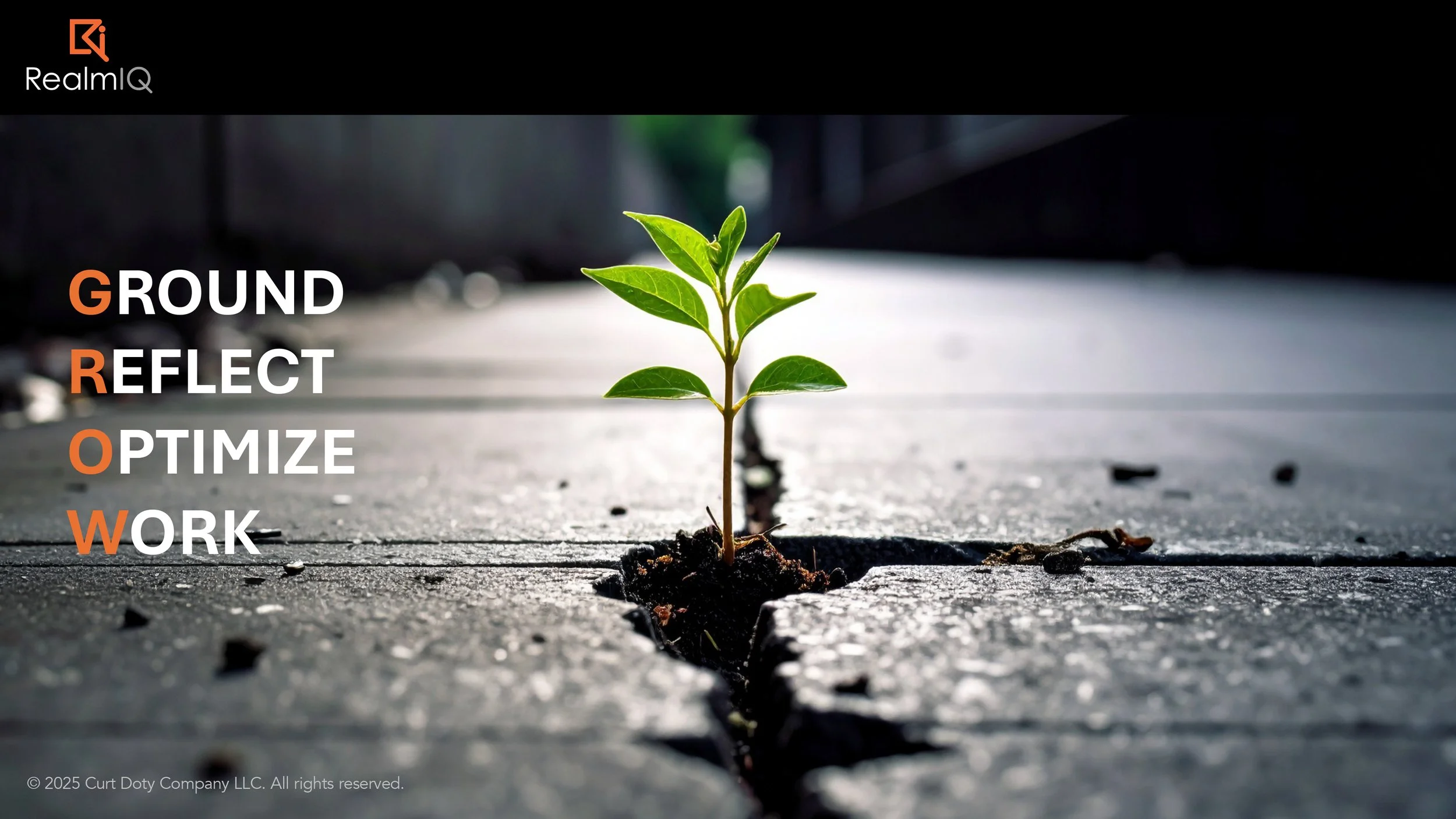
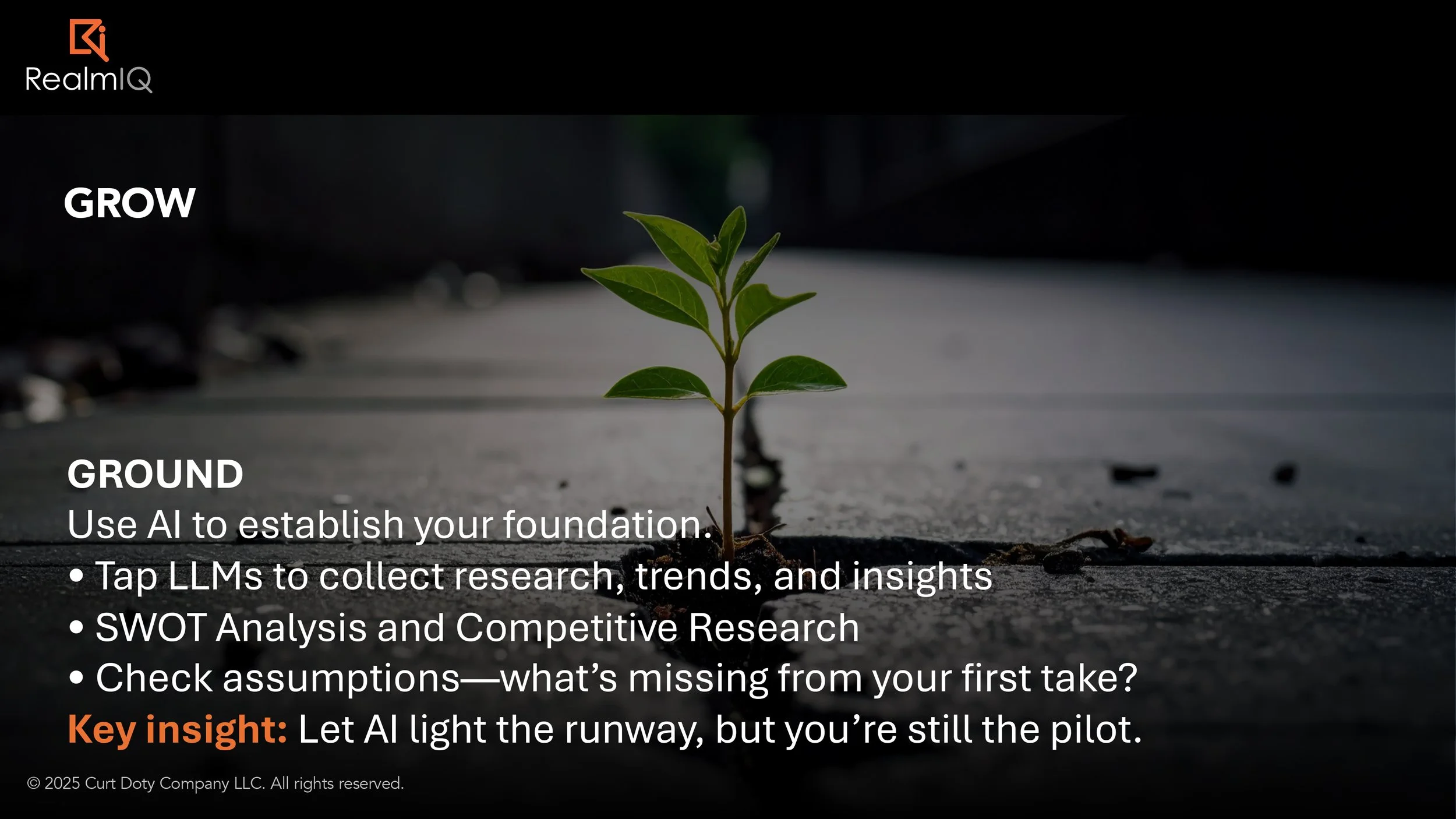
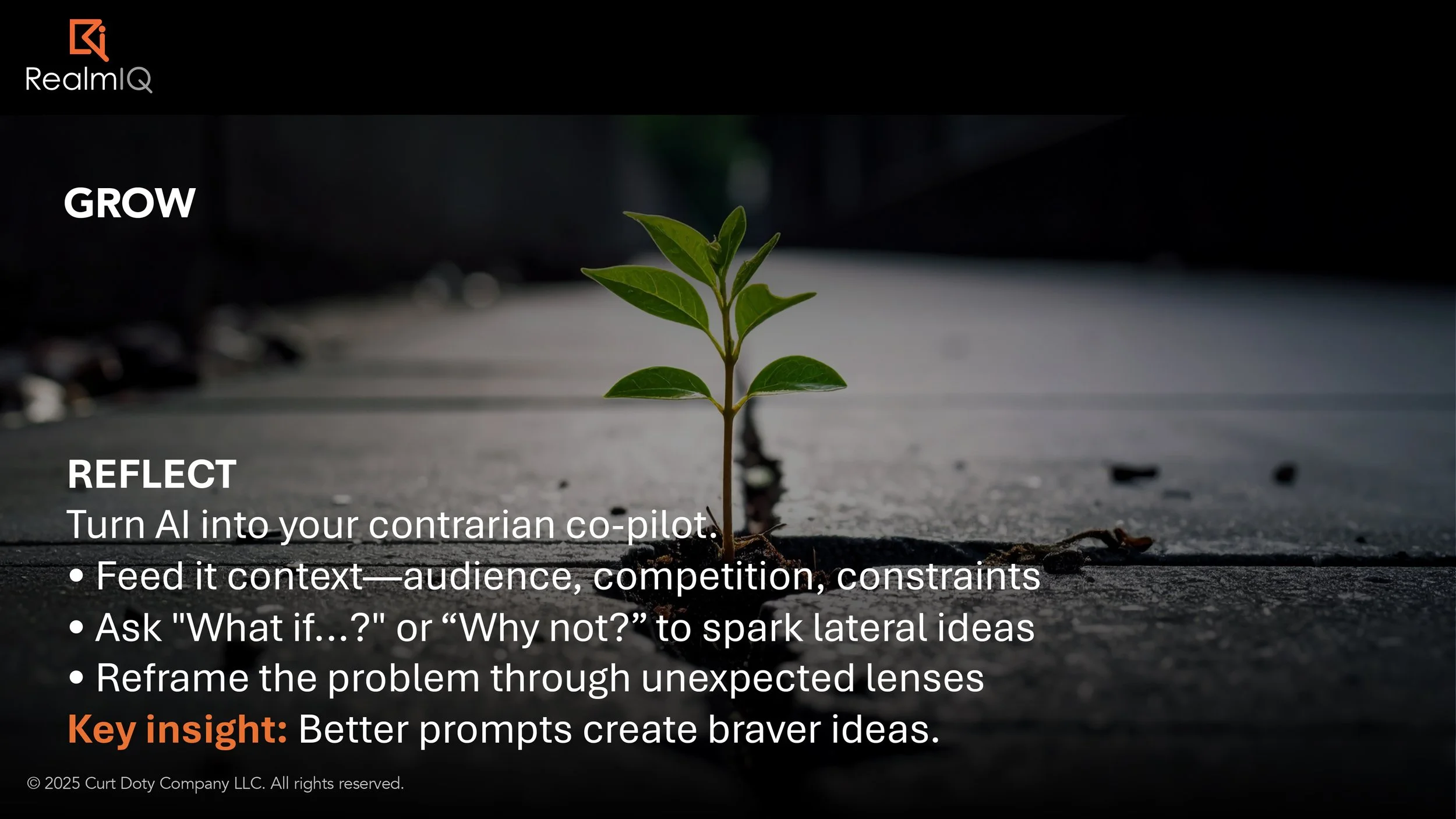
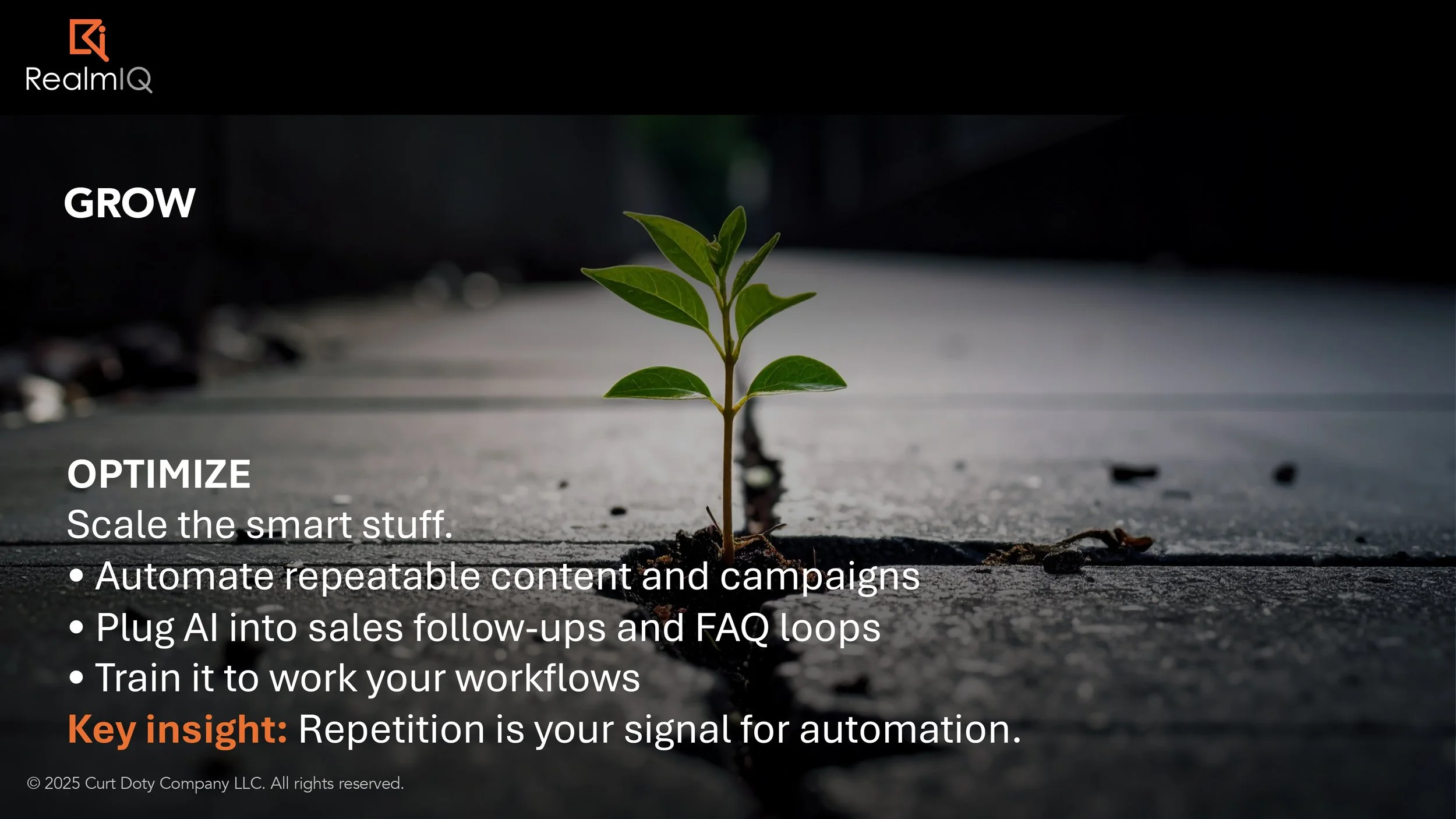
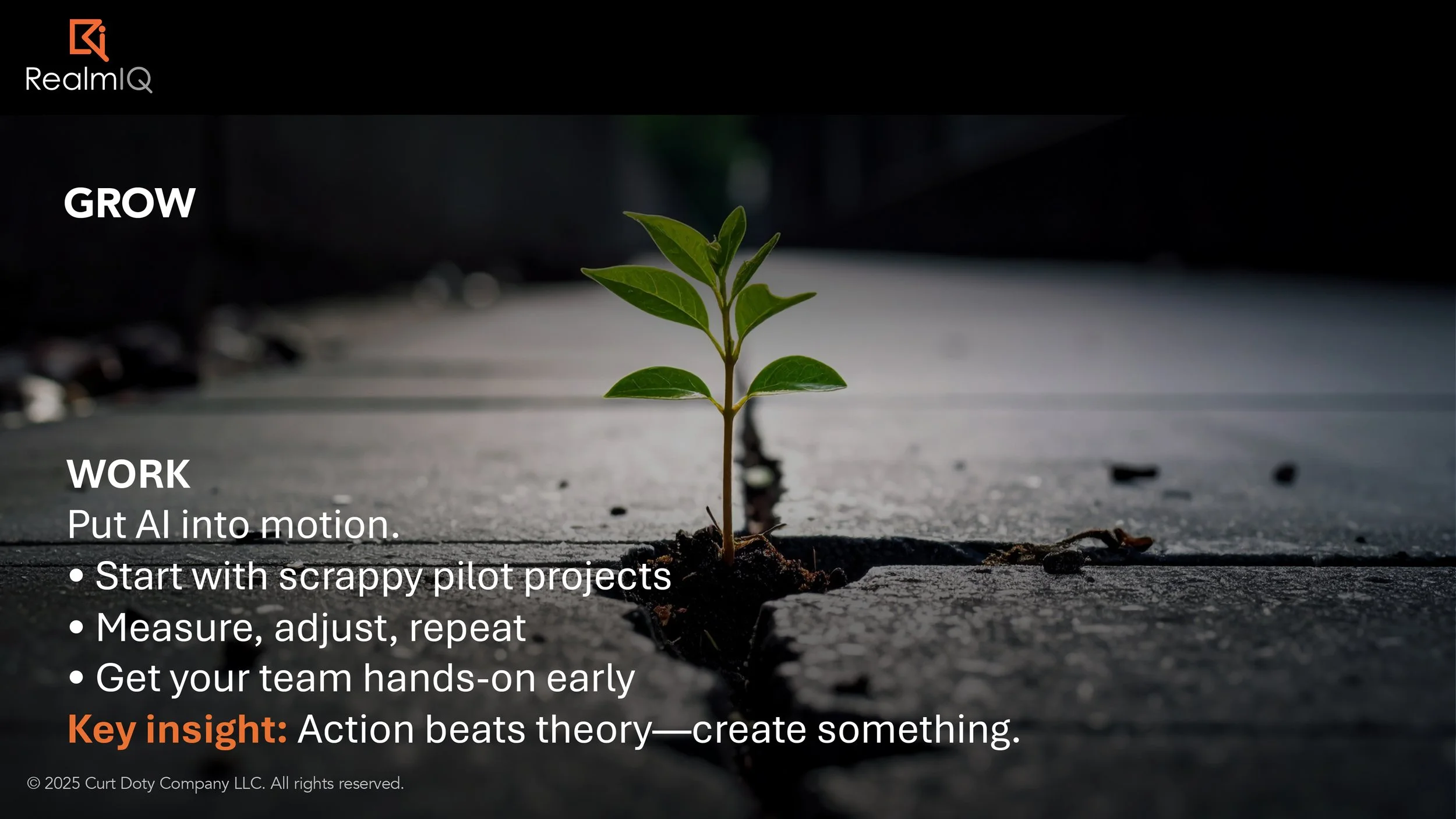
I shared my GROW process of integrating AI at work. The roadmap is simple, even if execution isn’t. Start with real work, not experiments. Identify repeatable tasks. Insert AI where it actually helps. Build new workflows. Then teach others. That’s how this scales. Not through mandates from the C-suite, but through practical use cases that prove value.
And let’s not ignore the shiny object moment with avatars and video onboarding. Cool? Yes. Necessary? Debatable. But it does point to something bigger: AI isn’t just changing how we work—it’s changing how companies communicate, onboard, and present themselves. The risk, as always, is confusing novelty with value.
At the end of the day, this all comes down to a mindset shift. You can fight it, fear it, or ignore it. Plenty still are. But the people leaning in—thoughtfully, not blindly—are the ones gaining leverage. Not because AI is magical, but because they’re learning how to use it with intent.
Bottom line: AI is not replacing HR. But HR will absolutely be reshaped by AI. And the ones who figure out governance, not just usage, are the ones who will lead us into the future. Thanks to Leah Pelletier and Jeffrey Maholtz for the invite.
About the Author
Curt Doty is a former studio executive and award-winning creative director with deep leadership experience across the entertainment and branding industries. Ten years in Television. Ten Years in Movies.
As the founder of CurtDoty.co, a creative consultancy, Curt has led integrated marketing, multi-channel storytelling, branding, identity, and user experience initiatives for a diverse roster of clients.
Over the past 15 years, Curt has leaned into innovation—leading R&D projects at Apple, Toshiba, and Microsoft, and pioneering interactive content.
Today, Curt’s work also explores the intersection of AI and entertainment. A sought-after fractional leader (CCO, CMO), speaker, and AI educator, he focuses on demystifying AI for creatives and executives alike.
Curt recently launched the CLOWD AI Film Festival. Check it out here and be part of this growing community.
Curt is a sought after public speaker having been featured at Mobile Growth Association, Mobile World Congress, App Growth Summit, Promax, CES, CTIA, NAB, NATPE, MMA Global, New Mexico Angels, PRSA, EntrepeneursRx, Digital Hollywood, SHRM, Streaming Media NYC, and Davos Worldwide. Download his speaker presskit here.
Through public speaking, keynotes and podcasts, Curt is continuing his role as a visionary voice in the future of creativity. He is now a board member of The Human AI Innovation Commons, Encoding Equity Into AI-Generated Prosperity. A framework for ensuring the innovations arising from Human – AI collaborations benefit humanity broadly, not just corporate shareholders.