1984 Wasn’t a Warning. It Was a Blueprint.
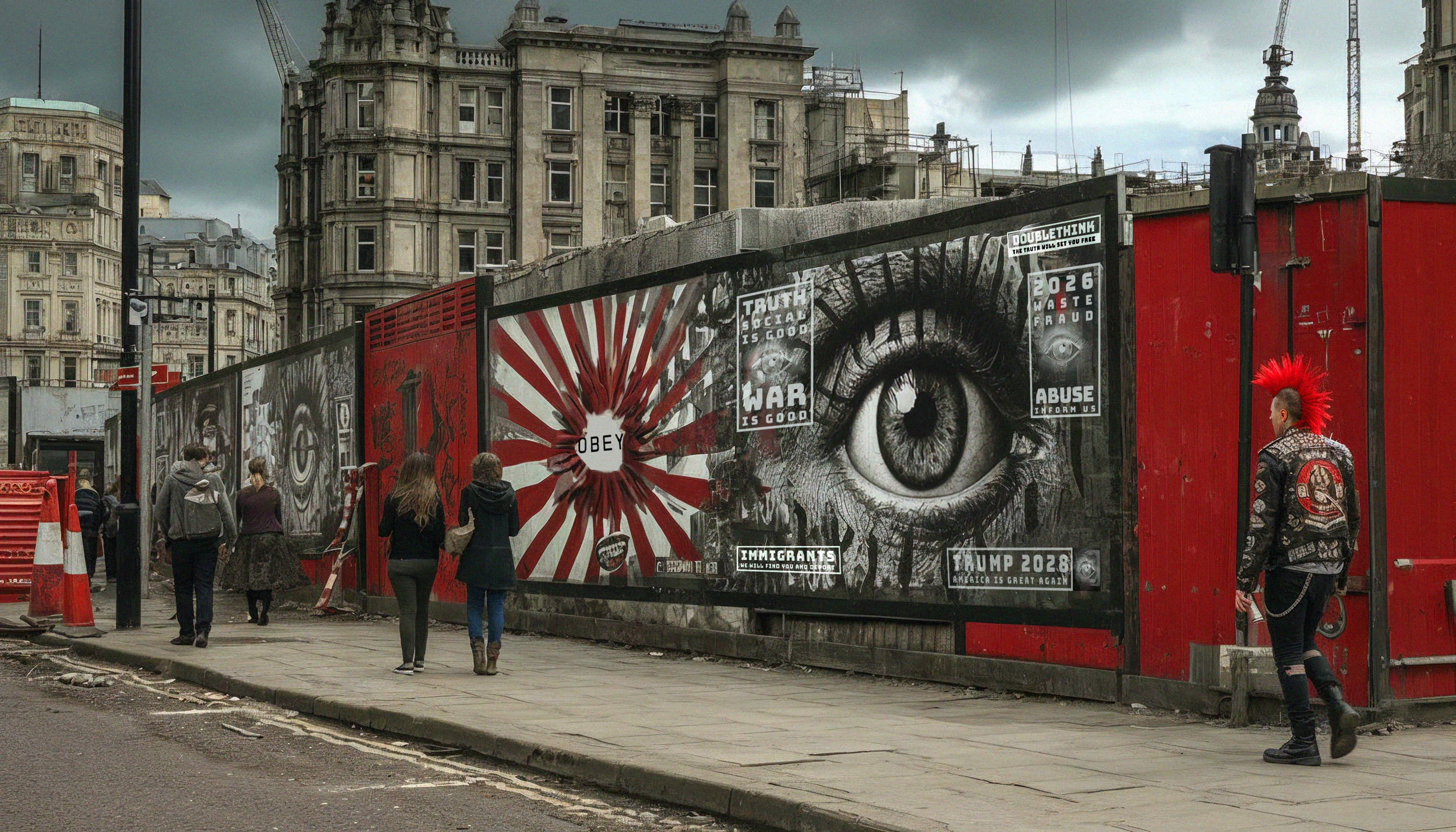
Google Nano Banana 2: Curt Doty
It was 1984, Trafalgar Square. I was a young aspiring illustrator having graduated from Art Center a few months before. I took a six-week excursion through Europe before starting my career in NYC. I had just read George Orwell’s 1984 on some of my Eurail adventures. Yet, here I found myself at a location in the origin of this prophetic novel. Ironically, the movie 1984 was playing in Piccadilly and I decided to see how this tale came to life on the screen. It was sold out and I found myself in the middle of an enthusiastic crowd. The film was OK. But what lived in my head at the time seemed better. Now in 2026, those images in my head are being realized everyday.
In 1949, George Orwell published 1984, a dystopian novel about a society ruled by surveillance, propaganda, and the manipulation of truth. At the time, it was seen as a cautionary tale about totalitarian regimes. In 2026, it reads less like fiction and more like a user manual.
Orwell imagined a world where language itself became a weapon—where governments could control people not just through force, but through the careful engineering of reality. In the novel, the Party creates a language called Newspeak, designed to eliminate dissent by eliminating the words needed to express it.
The Party’s most famous invention was Doublethink—the ability to hold two contradictory ideas in your head and believe both to be true.
As Orwell writes:
“The Party told you to reject the evidence of your eyes and ears. It was their final, most essential command.”
Sound familiar?
Today we don’t call it Doublethink. We call it “Alternative Facts.”
The phrase famously entered the modern lexicon in 2017, when a political spokesperson defended demonstrably false claims about crowd sizes. The statement was meant to justify a lie—but it accidentally revealed something deeper: the normalization of Orwellian language.
In 1984, the Ministry of Truth rewrites history daily. Newspapers are altered, records disappear, and inconvenient facts are erased so the Party is always correct.
Orwell describes it chillingly:
“Who controls the past controls the future. Who controls the present controls the past.”
Now look around.
Social media algorithms amplify misinformation faster than truth can catch up. Politicians reframe lies as narratives. Tech platforms quietly adjust moderation policies depending on political pressure. Oligarchs control the media. Entire realities now exist inside digital echo chambers.
Truth isn’t debated anymore.
It’s versioned.
And then there’s surveillance.
In Orwell’s world, citizens live under constant watch by “Big Brother,” with telescreens observing every move. In 2026, we voluntarily carry the telescreen in our pocket.
Your phone knows where you are. Your smart speaker listens for commands. Your car tracks your driving habits. Your social media profile maps your beliefs, preferences, and vulnerabilities.
The difference?
Orwell’s citizens were forced to live under surveillance.
We opted in.
Even more unsettling is the role artificial intelligence now plays in shaping perception. AI systems curate news feeds, generate content, and increasingly influence what people see as reality. When algorithms decide what information reaches billions of people, the line between truth and narrative becomes dangerously thin. RIP TikTok and CBS News.
As someone watching the AI revolution unfold, I can’t help but think Orwell underestimated one thing.
He thought authoritarian control would come from governments.
Instead, it may arrive through algorithms, platforms, and data monopolies.
The irony is that Orwell believed language manipulation required centralized power.
Today it only requires virality.
In 1984, the main character Winston Smith tries to hold on to a simple idea—that objective truth still exists.
He writes in his diary:
“Freedom is the freedom to say that two plus two make four. If that is granted, all else follows.”
In 2026, that line might be the most radical statement of all.
Because once a society accepts that two plus two can equal whatever the loudest voice says it equals, reality itself becomes negotiable.
And that’s when dystopia stops being fiction.
It becomes policy and a bitter reality.
About the Author
Curt Doty is a former studio executive and award-winning creative director with deep leadership experience across the entertainment and branding industries. Ten years in Television. Ten Years in Movies.
As the founder of CurtDoty.co, a creative consultancy, Curt has led integrated marketing, multi-channel storytelling, branding, identity, and user experience initiatives for a diverse roster of clients.
Over the past 15 years, Curt has leaned into innovation—leading R&D projects at Apple, Toshiba, and Microsoft, and pioneering interactive content.
Today, Curt’s work also explores the intersection of AI and entertainment. A sought-after fractional leader (CCO, CMO), speaker, and AI educator, he focuses on demystifying AI for creatives and executives alike.
Curt recently launched the CLOWD AI Film Festival. Check it out here and be part of this growing community.
Curt is a sought after public speaker having been featured at Mobile Growth Association, Mobile World Congress, App Growth Summit, Promax, CES, CTIA, NAB, NATPE, MMA Global, New Mexico Angels, PRSA, EntrepeneursRx, Digital Hollywood, SHRM, Streaming Media NYC, and Davos Worldwide. Download his speaker presskit here.
Through public speaking, keynotes and podcasts, Curt is continuing his role as a visionary voice in the future of creativity. He is now a board member of The Human AI Innovation Commons, Encoding Equity Into AI-Generated Prosperity. A framework for ensuring the innovations arising from Human – AI collaborations benefit humanity broadly, not just corporate shareholders.